Why We’re Returning to Real Things in a Digital World
Just a few years ago, luxury meant more. More features, more screens, more possibilities.
Today, it increasingly means… less. Fewer stimuli. Less rush. Less digital. And more of what is real.
Something has shifted. Not in technology — in us. In what we’ve started looking for, what we find ourselves missing, and what we’re willing to pay for. This piece is an attempt to answer the question: why, at the most electrified moment in human history, are more and more people reaching for a record player, a printed newspaper, and a watch without a battery?
A World That Accelerated Too Fast
Streaming replaced listening to music. Spotify serves up playlists before we even know what we want — the algorithm knows our tastes better than we do, or at least that’s how it feels. We swap reading books for audiobooks playing “in the background” — while cooking, running, driving. Newspapers lost out to the feed we refresh every few minutes in search of a new dose of information we’ll have forgotten moments later.
The problem isn’t technology itself. It’s what technology does to our attention. As
Nicholas Carr wrote in The Shallows:
“”The internet is turning us from deep readers into scanners of
information.””
A brain that spent decades learning to read linear, long-form texts begins to prefer shortcuts. We hop between tabs, scroll mid-sentence, read headlines instead of articles. This isn’t laziness — it’s adaptation to an environment that rewards speed and punishes stillness.
The side effect is an ever-growing sense of emptiness. We consume more than ever, yet we rarely feel like we’ve truly experienced anything. Technology gave us access to everything — and at the same time took away something equally important: focusand depth of experience.
Offline is the new luxury
According to analyses cited by the Financial Times, the peak popularity of Facebook, Instagram, and TikTok came in 2022, and by 2024 people worldwide were spending about 10% less time on these platforms than two years earlier. It may not be a revolution, but it’s a clear enough signal that something is shifting.
We won’t be logging off the internet — for many of us it’s a tool for work, staying in touch, and managing everyday life. But at the same time, we’re experiencing a kind of technological saturation: the feeling that the digital world has reached a critical mass of presence in our lives, and that each new innovation overwhelms rather than delights. The internet has also stopped exciting us the way it once did — instead of spontaneity and variety, it now largely offers an algorithmic monoculture and an overabundance of low-quality content. Add to that an attention crisis. Everything is fighting for our time and interest, and we find ourselves increasingly longing for things that aren’t trying to sell us something or pull us in.
Online, more and more voices are predicting that 2026 will be the year of analog. Not a return to the pre-internet era — that’s neither realistic nor something anyone actually wants. It’s about something else: a year of more conscious choices, in which modern technology doesn’t get the final word. Because it doesn’t have to.
Recently, a friend of mine shared a reel in which a woman’s hands leafed through a thick notebook — covered in photographs, newspaper clippings, and handwritten notes. The caption read: “Don’t let Instagram be the only archive of your memories.” That sentence stopped me. Because there’s something deeper in it than an aesthetic trend — it’s a question about what remains when a server goes down or an account gets deleted. How much of our memories exists in a form we can hold in our hands?
Why We’re Returning to Analog
In 2023, vinyl record sales in the US exceeded CD sales again — for the first time since the 1980s. By 2024, vinyl accounted for nearly three-quarters of physical music format revenue, and in the UK sales reached 6.7 million units — the highest in three decades. Not because vinyl is more convenient. Because it isn’t. You have to buy a record, store it, take it out of the sleeve, clean the needle, set the speed. Flip it after twenty minutes.
And that’s exactly the point.
Vinyl demands time, attention, and ritual. You can’t put it on in the background and forget about it. Listening becomes an activity — not a backdrop. As Jack White put it:
“”Vinyl is a format that forces you to listen.””
That compulsion to focus, which for previous generations was simply the norm, has today become something rare — and therefore precious. Vinyl is coming back not as a collector’s curiosity, but as a conscious choice by people who want to reclaim control over their own attention. It’s also worth noting that our relationship with online music is changing. Spotify Wrapped has become so ubiquitous that it’s turned into a meme — and that’s precisely why some people have stopped sharing it. Partly out of stubbornness, partly out of fatigue with a format everyone has seen a thousand times. Or maybe because what we listen to is something we increasingly want to keep just for ourselves.
Less Screen, More Paper
The same pattern shows up in the return to handwriting and paper more broadly. The market for notebooks, planners, and stationery is seeing significant growth — companies making elegant paper diaries and notebooks, like Moleskine and Leuchtturm, report increased sales particularly among young adults between 18 and 35. It’s a surprising generation to be nostalgic for paper — and yet it makes sense. More and more people feel the need to write their thoughts on paper precisely because it’s an activity separate from their phone, their screen, and their notifications.
Mental health experts have recommended journaling for years — not as a substitute for therapy, but as a tool for organising emotions, reducing tension, and noticing patterns that tend to escape us in the rush of daily life. Paper doesn’t talk back, doesn’t send notifications, and doesn’t judge. It’s an environment where a thought can simply exist.
Paper is also winning back readers. And — paradoxically — this trend has been accelerated by social media: #booktok and #bookstagram turned reading into a topic of conversation, recommendations, and small rituals. In their wake, book clubs are growing — grassroots ones started by friends, but also ones run by bookshops and libraries. The book is once again a reason to meet offline. In many surveys, Generation Z says it prefers reading on paper to e-readers — the touch of a real book matters, as does the fact that reading doesn’t happen on the same device used for everything else. Research published in Scientific American confirms that content read on paper is better retained than content read on screens.
Pop culture is doing its part too. Dua Lipa runs her own book club, regularly recommending titles and interviewing authors — including Olga Tokarczuk. It only confirms that reading and talking about books is not just fashionable today, but genuinely cool.
Analog vs. Digital — Four Examples
Vinyl vs. Spotify
Spotify gives you access to over 100 million tracks in a fraction of a second. That’s undeniably impressive. But unlimited choice paradoxically reduces the value of each individual decision. When you can have everything, nothing is special. Vinyl gives you a constraint — you have this one record, this one side, these forty minutes of music. And it’s precisely through that constraint that each listen takes on meaning.
Book vs. Audiobook
An audiobook is practical. You can “consume” it while doing other things. But consumption isn’t the same as reading. When we read, we pause, we go back to the previous paragraph, we scribble notes in the margins, we put the book down and think. An audiobook flows. A book has to be lived. As Umberto Eco wrote:
“”The person who doesn’t read lives only one life.””
A physical book is more than a vessel for text — it’s an object we remember by touch, by smell, by where it sits on the shelf. Research confirms we retain content from printed texts better than from screens.
Newspaper vs. News Website
A news website is an infinite scroll designed so you never finish reading — every headline leads to another, every click generates another recommendation. The algorithm doesn’t optimise for what’s important; it optimises for what will keep you on the page the longest. A printed newspaper has an editorial team that made choices — someone decided this matters and deserves the front page. That hierarchy, imperfect as it is, is a form of service to the reader.
Mechanical Watch vs. Smartwatch
A smartwatch tracks your steps, heart rate, blood oxygen, sleep quality, and a hundred other parameters. It is objectively more useful than a mechanical watch. But usefulness isn’t everything. A mechanical watch — as Jean-Claude Biver, one of the greatest reformers in watchmaking, once noted — “is not about time. It is about emotion.” It’s an object you can pass on to your children, something that acquires patina and history with age. No smartwatch will survive to a second generation.
The Analog Renaissance — What Else Is Coming Back
Beyond music and paper, the analog turn is visible in some surprising places.
In photography, film cameras and old compact digital cameras from the 2000s are making a comeback — they produce images that are less “perfect” but more real,with a slight overexposure, grain, and happy accidents that no AI-calibrated smartphone will ever replicate. According to data from the Camera & Imaging Products Association, around 1.05 million compact cameras were shipped worldwide in the first half of 2025. Film is doing well enough that Fujifilm has announced a five-billion-yen investment in expanding Instax production, in phases from spring 2026.
Wired headphones are returning too. For Generation Z, the cable has stopped being just a technical detail — as British Vogue journalist Daniel Rodgers noted in conversation with The Guardian, wired headphones have become something more than a fashion statement, spotted on celebrities like Lily-Rose Depp, Bella Hadid, and Paul Mescal. According to Rodgers, they’re a simple, analog way of cutting out stimulation and going into “do not disturb” mode in the real world. “Technological progress is treated as compulsory, and retro gadgets offer a way to opt out,” he adds.
Interest in dumbphones is also growing — basic phones with essential functions, no apps, no scrolling. HMD reports a 10% increase in sales of such phones in 2024, and the specialist shop Dumbwireless reportedly sold over 70,000 products in a single month. This isn’t a retreat from technology — it’s an attempt to limit it to the functions that actually serve you.
Slow Life and Fine Dining — The Luxury of Time
The same mechanism appears beyond technology — in food, travel, interior design.
For decades, eating became faster and faster. Fast food, takeaway, meal prep, a protein shake instead of breakfast. Time spent eating was treated as a waste — something to be minimised so you could get back to the “real” things. Today, the world’s best restaurants are doing exactly the opposite.
Noma in Copenhagen, Osteria Francescana in Modena, Geranium — these aren’t places you go to “grab lunch.” They’re experiences lasting two, three, sometimes four hours. Each dish is small, considered, often explained by the chef or waiter. You’re not paying for calories; you’re paying for time, attention, and narrative.
As Massimo Bottura, head of Osteria Francescana, has said:
“”Food is memory, culture, and emotion — not just a product.””
The slow life movement goes in the same direction, but further — beyond the restaurant and into everyday life. It’s not an ideology of doing nothing. It’s a conscious slowing down: a walk instead of rushing, a conversation instead of a message exchange, cooking instead of ordering, presence instead of multitasking. Slow life is a rebellion against the culture of optimisation, which treats every moment as a resource to be managed.
Time and attention are becoming the luxury — goods you cannot buy, only choose.
Analog Is Not the Past
An important caveat: this isn’t nostalgia. Nostalgia is a longing for a past that often no longer exists. What we’re talking about is something different — it’s a conscious choice by people who know the digital alternatives perfectly well and opt for analog anyway. Or perhaps because of that very knowledge.
Leica still makes manual cameras — expensive, unwieldy, requiring skill and patience. And they sell. Porsche keeps the manual gearbox in the 911, even though automatics are faster and more fuel-efficient — because customers want to feel connected to the car. Good magazines — from Monocle to the Polish Pismo — are still printed, and still have readers willing to pay for paper. Craft is coming back into favour: ceramics, bookbinding, weaving, blacksmithing are drawing levels of interest they haven’t seen in decades.
This isn’t sentiment. It’s a response to digital exhaustion — a search for things that have weight, smell, history, and won’t disappear with the next system update.
What About Cars?
Cars may be the clearest example of the tension between technical perfection and emotional experience.
Modern cars are objectively the best in history — safer, faster, more economical, and more reliable than anything that drove on roads twenty years ago. But they’re increasingly impersonal. As Jeremy Clarkson observed, with his characteristic wryness: “Modern cars are so good they’ve become boring.”
The dashboard has become one giant touchscreen. The power steering is calibrated so precisely you can’t feel the road. The gearbox shifts faster than human reflexes. The car increasingly decides for you. And a fundamental question arises: are we still driving, or are we merely supervising?
That’s why interest in classics, youngtimers, and restomods is growing. Not because they’re technically superior — they’re inferior by every measurable parameter. But something still exists in them that can’t be digitised: a direct, unfiltered relationship between person and machine. The sound of an engine that responds to the throttle with joy. The resistance of a steering wheel feeding back information from every bend. A manual gearbox drawing you into partnership with the machine.
As Ferdinand Piëch, one of the most important visionaries in automotive history, put it:
“”A car is more than a means of transport. It is emotion.””
It’s a bit like fine dining behind the wheel: technically speaking, a bus would get you there just as well. But that’s not the point. The point is to feel it, to live it, to remember it.
RCR — The Car as an Experience
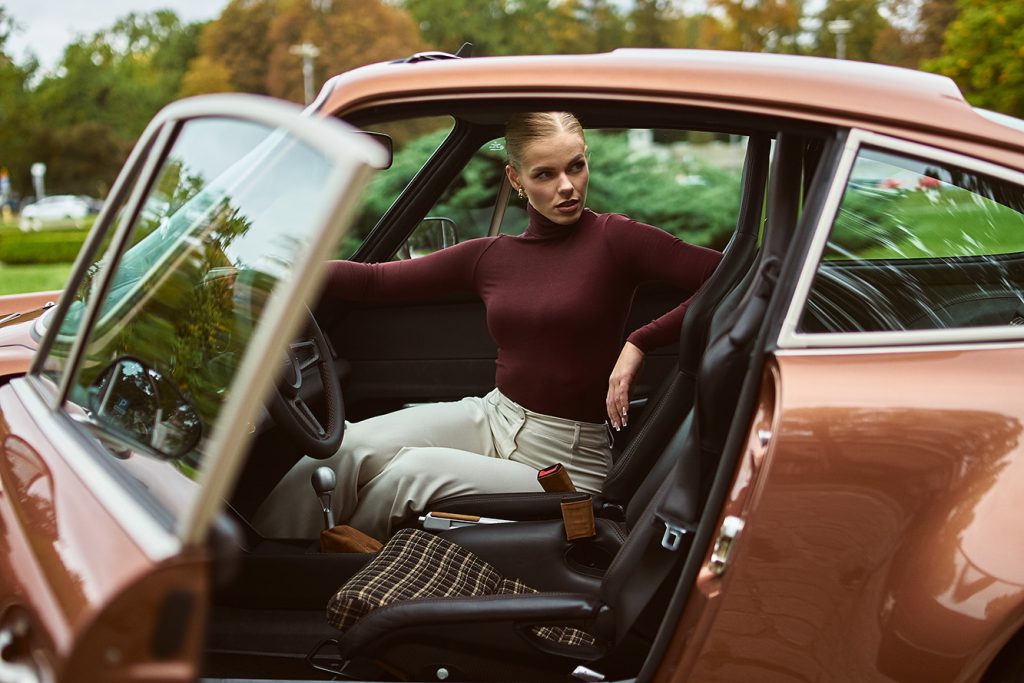
In this context, it’s worth looking at RCR — a brand that makes no attempt to compete with Tesla or the latest models from the premium segment. RCR asks an entirely different question. Not: “how fast will you get there?” but: “how do you want to feel along the way?”
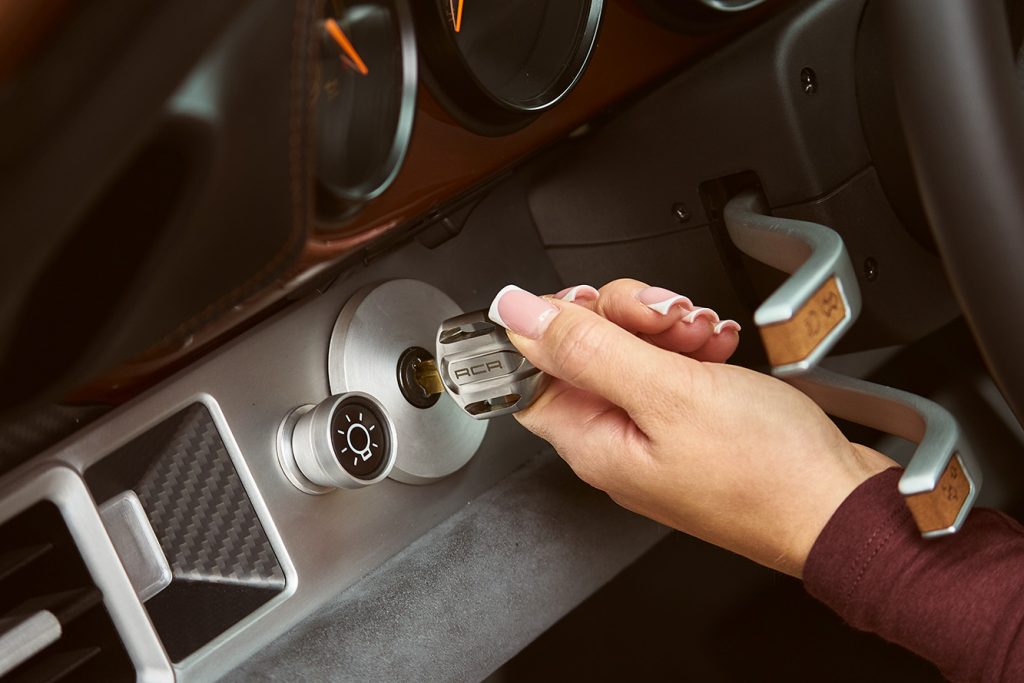
That distinction matters. In a world where the car is increasingly becoming an intelligent, semi-autonomous mobile device, RCR consciously moves in the opposite direction. It bets on directness: the sound of an engine that responds to every press of the throttle, the resistance of a steering wheel feeding back information from the road surface, a manual connection with the machine that demands engagement and rewards it with satisfaction.
This is exactly the same mechanism that draws people back to vinyl, film cameras, and paper notebooks. Not because alternatives don’t exist — they do, and they’re more convenient. But because convenience is no longer synonymous with value. What counts is the experience: complete, engaging, memorable.
An RCR is not a product in the traditional sense. It’s a proposal of a relationship — between person and machine, between driver and road. And in a world that increasingly delegates decisions to algorithms and driver-assistance systems, that kind of relationship is becoming something rare. And rarity, as we know, is the foundation of luxury.
What Is the New Luxury
For a long time we defined luxury by rarity and price. A diamond is luxurious because there are so few of them. A Patek Philippe watch is luxurious because it costs as much as a flat. That definition hasn’t disappeared — but alongside it, a new one has emerged.
The new luxury isn’t about something being more advanced, more exclusive, or more expensive. It’s about something being real, demanding, engaging, and lasting. It requires something from us — time, attention, presence — and in return offers an experience that cannot be skipped or consumed on the go.
As Dieter Rams, the legendary designer whose work inspired Jonathan Ive in designing Apple products, put it:
“”Good design is as little design as possible.””
Less is more — not as asceticism, but as precision. Stripping away everything superfluous so that only what is essential remains.
And perhaps today one can add: good luxury means as little technology as possible standing between you and the experience. Not the absence of technology — but technology that doesn’t impose itself, that serves rather than dominates.
In a world that keeps accelerating, surrounded by devices designed so that you never get bored, never have to wait, and never stop — the greatest luxury has become precisely this: a moment of stillness. An object that demands your attention. An experience that stays with you.
Analog is not an escape from the future. It is a choice for the quality of the present.