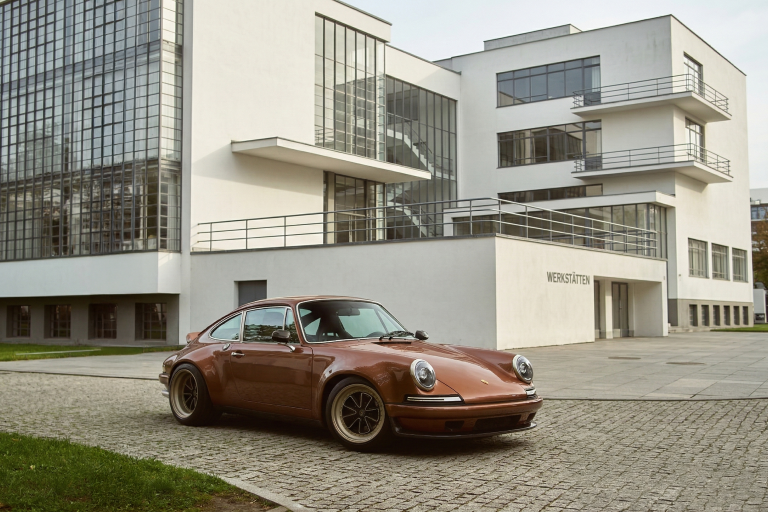
Why at RCR we believe form must follow function
In 1919, in the German city of Weimar, architect Walter Gropius founded a school that would fundamentally change the way people think about design. It was called the Bauhaus.
Its idea was simple yet revolutionary: design should unite art, craftsmanship, and engineering, and everyday objects should be created with the same care and intention as works of art. Instead of decoration and ornament, the focus shifted to function, construction, and the honest use of materials.
Bauhaus rejected the excess and ornamental aesthetics of earlier eras. In their place came simple forms, geometric proportions, and objects designed according to how they work and what they are meant to do.
From this philosophy came one of the most influential principles in the history of design:
Form follows function.
The influence of Bauhaus is visible almost everywhere today. In the architecture of modern cities, in furniture design, in typography, and in industrial products. Minimalist buildings of glass and concrete, Marcel Breuer’s steel chairs, or Wilhelm Wagenfeld’s iconic lamps became defining objects of modern design.
But Bauhaus was never just a style.
It was, above all, a way of thinking about design.
A product should be honest about its materials.
Its form should emerge from its construction.
And it should be beautiful because it works well.
Although Bauhaus emerged more than a century ago, its philosophy feels surprisingly close to how we think about automobiles at RCR.
Form defined by driving
In a sports car, every element exists for a reason.
The shape of the body is not decoration.
The line of a fender is not a stylistic gesture.
An air intake is not a visual detail.
Every line has a purpose.
Aerodynamics, cooling, visibility, and driver ergonomics define the form. That is why well-designed sports cars feel naturally proportioned and timeless. Not because someone tried to make them look beautiful, but because their shape is a direct result of what they need to do.
In that sense, automotive design can be very close to Bauhaus thinking.
Honest materials
One of the fundamental principles of Bauhaus was honesty of materials.
A material should never pretend to be something else. It should be used according to its natural properties and character.
At RCR, this principle is straightforward.
Aluminium is aluminium.
We do not disguise it as something else.
Leather is leather.
Natural, tactile, and capable of aging with dignity, gaining character with every kilometre.
Metal switches are metal, because they are meant to feel precise and durable, not just look appealing in photographs.
We are not interested in imitation.
The analog experience
In an era of digital interfaces and touchscreens, it is increasingly difficult to find cars that offer a purely mechanical driving experience.
Restomods make it possible to return to that world.
A world where:
the steering wheel communicates directly with the front wheels
the throttle responds instantly
the sound of the engine comes from the engine itself, not from speakers
It is not a simulation of driving.
It is driving.
Craftsmanship and engineering
The Bauhaus philosophy was built on the idea of bringing together artists, designers, craftsmen, and engineers.
At RCR, the process looks remarkably similar.
The creation of each car brings together:
engineers and constructors
designers
mechanics
upholsterers
craftsmen working with leather and metal
Every detail is the result of both technical knowledge and skilled manual work.
Why this philosophy still works
Good design does not age.
That is why Bauhaus architecture still feels modern today.
That is why furniture designed a hundred years ago is still produced.
And that is why automobiles whose form truly follows function remain timeless.
At RCR, we are not trying to follow stylistic trends.
We build cars where form is the consequence of performance, and materials speak the truth.
Just like in Bauhaus.