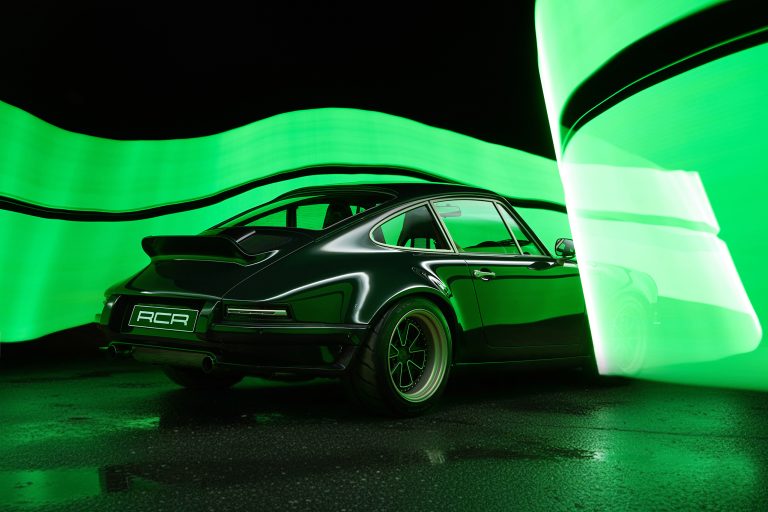
RCR Regent was never designed to exist only in daylight or static surroundings. From the very beginning, the car was developed with the understanding that form, proportion and surface come alive only when confronted with contrast — light and shadow, motion and stillness, restraint and expression.
This latest photo session captures Regent exactly in that space.
Form Revealed Through Light
The silhouette of the 911 has always been about tension. The long roofline, compact cabin and muscular rear create a shape that demands precision. In Regent, those proportions were revisited with contemporary intent — not exaggerated, not softened, but sharpened where it matters.
Light becomes a design tool here. Reflections trace the curvature of the bodywork, emphasizing surfaces shaped by engineering rather than ornament. Every line visible in these images exists for a reason, rooted in geometry, airflow and balance.
Modern Presence, Classic Architecture
While the architecture remains unmistakably classic, Regent speaks a modern visual language. The lighting elements, stance and wheel fitment place the car firmly in the present. LED technology integrates seamlessly into the familiar face of the 911, delivering clarity without visual noise.
The result is not nostalgia. It is continuity.
A car that acknowledges its origin while confidently existing in today’s context.
Movement Without Motion
Although stationary in the frame, Regent suggests motion. Long exposures and dynamic light trails underline the idea that this car is not a static object — it is defined by movement, by driving, by mechanical engagement.
This approach reflects how RCR works: development happens on the road, not only on screens or in studios. Geometry, suspension and balance are refined through real driving, and that discipline carries through to the visual identity of the car.
Interior: Function as an Aesthetic Choice
Inside, the same philosophy applies. Materials are honest. Aluminum is aluminum. Carbon remains visible where weight and structure matter. Leather and Alcantara are used not as decoration, but as interfaces between driver and machine.
The interior is calm, focused and intentional — a place designed to drive first, impress second.
Engine as the Core
At the rear sits the heart of Regent. Clean, purposeful and exposed with pride, the engine bay reflects RCR’s approach to mechanical design: performance, reliability and visual discipline treated as one.
Nothing is hidden unnecessarily. Nothing is excessive.
Regent as a Statement
These images are not meant to shout. They capture Regent as it is — precise, confident and quietly expressive. A car built through a long process of decisions, testing and refinement, rather than trends.
RCR Regent exists at the intersection of engineering and culture. Not as a reinterpretation for its own sake, but as a focused expression of what a modern restomod can be when discipline leads the process.