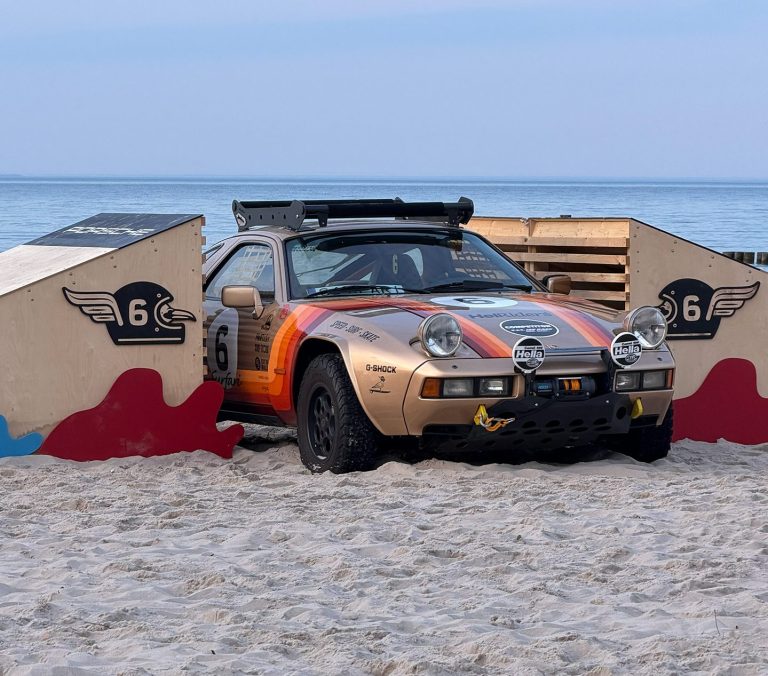
There are events that people attend specifically to see the exhibits.
And then there are those you drive to.
Hel Riders 2026 definitely fell into the latter category. The Hel Peninsula, Chałupy 6, classic Porsches, surfing, skateboarding, music, conversations by the cars, and that unique rhythm of a seaside weekend, where cars aren’t detached from life but become a natural part of it.
That’s exactly where RCR Heritage made its debut.
Not as a car displayed on a platform or a static object to be viewed from behind a barrier. Rather, as a car that best reveals its purpose in motion—on the road, among people.
Hel Riders — More Than Just a Rally
The fifth, anniversary edition of Hel Riders showed that this event is hard to pigeonhole into a single category. It’s not a classic car show, even though cars play a very important role here. It’s not a surfing festival, even though the beach, surfboards, and beach culture are its natural elements. Nor is it just a weekend lifestyle event.
Hel Riders works because it brings together several worlds that share a common thread: freedom, mechanics, style, and people who still appreciate the real thing.
For three days, the Peninsula became a gathering place for enthusiasts of classic cars, skateboarding, surfing, music, and road culture. Over a hundred crews arrived at Chałup 6 with unique cars, including many classic Porsches—machines that need no further explanation, as their language is understood by anyone who has ever grasped the essence of analog driving.
In that environment, RCR didn’t have to prove anything. It was enough just to be there.
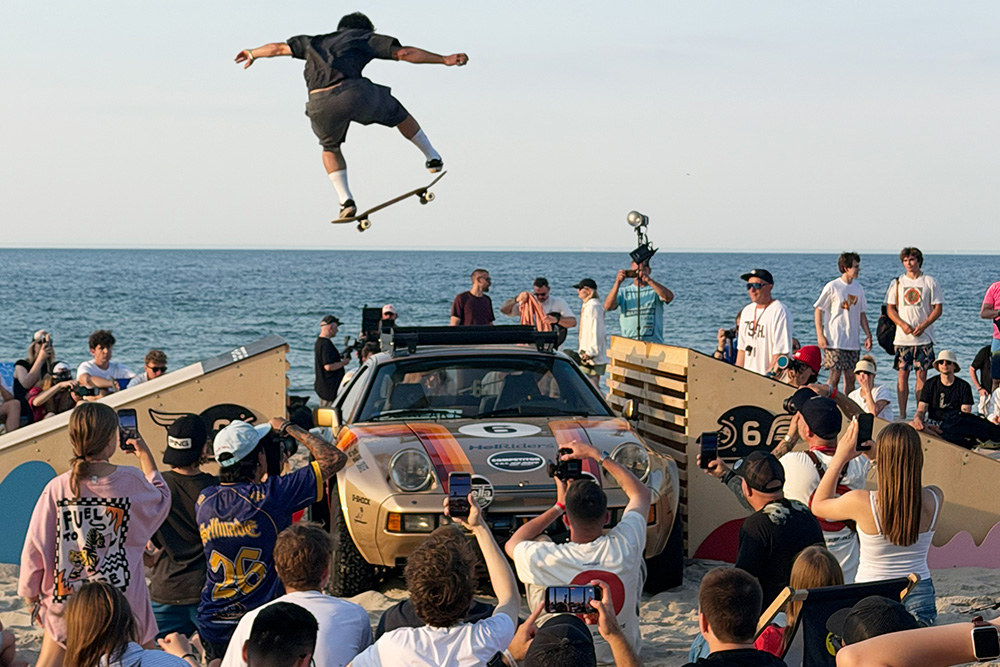
Not just cars
The Hel Riders program clearly demonstrated that the strength of this event lies not only in the number of exceptional cars, but in the entire world built around them. The official schedule included interviews and panel discussions on the Porsche Polska stage, a Porsche trivia contest, Shaper’s Club workshops on building surfboards, a surf gear swap meet, surf lessons, paddling, a Surf Contest, Surf Skate workshops, mini-ramp sessions, a skateboarding competition on the beach, film screenings, and concerts.
This combination was no accident. Hel Riders has its roots in a culture where motorcycling, surfing, skateboarding, music, and craftsmanship coexist naturally.
On the one hand, conversations about Porsche, its history, details, and mechanics. On the other—handcrafted surfboards, group surf trips to the Baltic Sea, skateboarding, the off-road Dirty Riders, and the evening music scene.
In this setup, the car isn’t just a standalone exhibit. It becomes part of a larger experience.
For RCR, this context is very close to our hearts. Our cars, too, are created at the intersection of several worlds—engineering, craftsmanship, aesthetics, and the thrill of driving. That’s why RCR Heritage’s presence at Hel Riders wasn’t just about participating in a motorsports event. It was about entering a community that naturally understands analog motoring.
Guests Who Provide Context
Hel Riders attracts not only cars but also people who provide a broader context for them. Among the guests was Piotr Sielicki from PorscheBlog.pl—one of the people who have been consistently promoting Porsche culture in Poland for years.
Jimek also showed up; his presence here felt natural not only because of the world of music, but also because of his passion for Porsche. In this context, the car ceases to be merely a technical object. It becomes part of a conversation about rhythm, emotion, precision, and a personal relationship with the machine.
Bedoes’ presence, in turn, showed that Hel Riders goes beyond the insular world of classic cars. This event brings together people from different worlds who share a similar sensibility—for style, the open road, sound, and things with their own character.
For RCR, this is a very natural environment—not just in terms of cars, but also culturally.
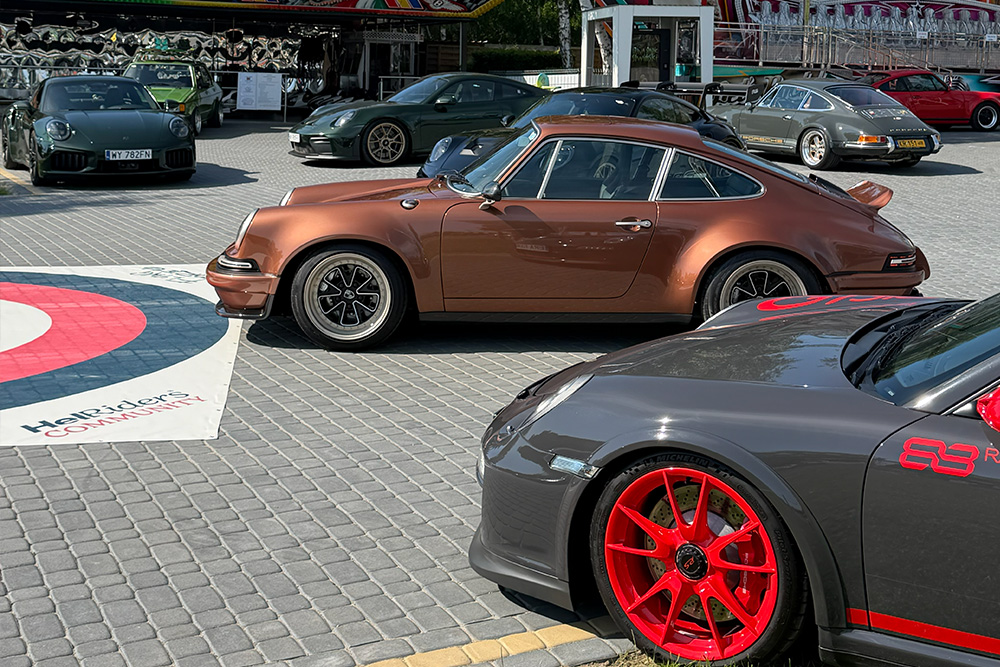
People, Cars, and Our First Evening in Władysławowo
From the very beginning, Hel Riders wasn’t a classic, closed-off exhibition. The very first day made it clear that this event functions more as a community gathering than a typical car show.
After the festival reception opened, participants began parking their cars at the Sowiński Amusement Park. This location gave the entire evening a completely different atmosphere than a standard exhibition space. The lights, the bustle, the summer energy of Władysławowo, and cars that are usually seen in completely different circumstances.
In the evening, a social event marking the start of the 5th edition of the Hel Riders Festival took place, along with a photo op for participants, organizers, and accredited media. Later, the gates of Lunapark were also opened to the residents of Władysławowo and guests of the Chałupy 6 campground.
It was an important moment, because classic cars had moved beyond a small circle of enthusiasts and become part of the local summer landscape.
The event was capped off by a nighttime air show—a flyby of three wingsuit jumpers in illuminated suits. It’s hard to imagine a more unusual backdrop for the classic Porsches, the conversations around the cars, and the first photos from the event.
In that setting, the RCR Heritage didn’t look like a museum piece. It was part of the scene: amid the amusement park lights, cameras, conversations, and people who came closer to figure out what exactly they were seeing.
Kaszëbë Surfari: The Journey as the Finale
The final day of Hel Riders brought the entire story of the event to a fitting close. Before noon, the Porsche Polska stage hosted a series of interviews and panel discussions, while a surf gear swap meet, the Shaper’s Club with board-building workshops, and Surf Skate workshops were taking place simultaneously.
It was still that same signature Hel Riders mix: Porsche, surfing, craftsmanship, movement, and people who move effortlessly between these worlds.
The highlight of the day, however, was the KASZËBË Surfari—a tourist rally covering over 150 kilometers of scenic routes, culminating in lunch or dinner against the backdrop of Łeba Castle. Following a briefing for the crews on the Porsche Polska stage and the announcement of the results of the poll for the “most surfer-friendly car” of the festival’s 5th edition, the cars in the Heritage category set off first, followed by those in the Modern category.
For RCR, it was one of the most important moments of the entire weekend.
Because a car can look great in a photo. You can position it in the right light, talk about the details, the proportions, and the craftsmanship. But only the road can tell if the whole project really makes sense.
RCR Heritage was built precisely around this relationship: driver, mechanic, throttle, brake, asphalt. No unnecessary filters. No pretending that classic motoring needs a digital translator to remain relevant.
The Kashubian roads, the changing light, and the rhythm of driving together showed the RCR in its natural environment—not as an exhibit, not as a project to be viewed from behind a barrier, but as a car meant to be driven.
The festival concluded with a surfers’ dinner at Karma and a screening of short surfing films. This symbolically brought the entire weekend to a close: the cars, the sea, the road, the sights, the sounds, and the people who came here not just to watch, but to truly be a part of it.
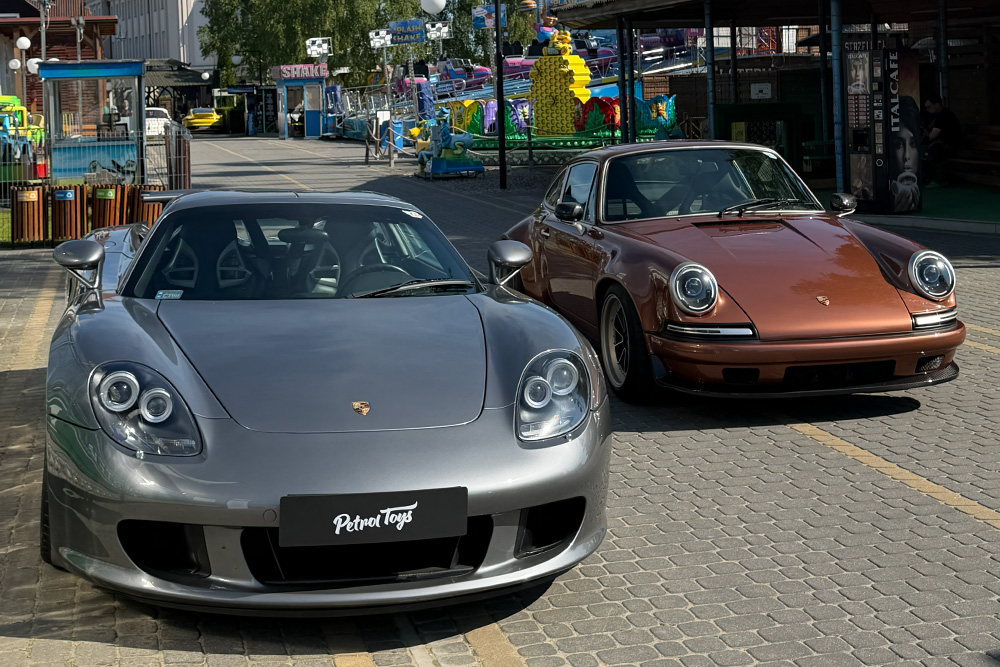
In good company
Hel Riders 2026 attracted cars that are hard to pass by without noticing. Among them were, among others, the Porsche Panamericana, the Ruf CSR, and the Carrera GT. The presence of such cars elevates the event, but it also sets a very demanding standard.
In an environment like this, it’s not enough to just have a nice car. You have to have your own language.
RCR Heritage doesn’t try to compete by making a splash. It doesn’t rely on exaggeration or random effects. It is a contemporary interpretation of the classic Porsche—hand-assembled, one-of-a-kind, and built around attention to detail, proportions, and the analog joy of driving.
Among cars with a rich history, a motorsports heritage, and collector’s value, the RCR stood out as something a little different. Not museum-like. Not nostalgic. More contemporary, yet still deeply mechanical.
We don’t recreate the past.
We build a new interpretation of it.
Why Hel Riders is a Good Fit for RCR
The best automotive events aren’t just about cars lined up in neat rows. The best events create a context in which you can understand why these cars exist in the first place.
Hel Riders has exactly that quality.
There are roads. There’s the sea. There’s a community. There’s a laid-back vibe, but it’s not haphazard. There are classic Porsches, but not in museum-like silence. There are people who can talk about the details, but who also understand that sometimes the most important thing is simply to get in and drive.
That’s why RCR Heritage was there.
Because the RCR isn’t a project designed for a cold, sterile display. It’s a car that needs space, light, sound, and the open road. It needs people who understand that analog motoring isn’t an escape into the past, but a conscious choice.
Built in Poland. Made for the road.
Hel Riders 2026 reminded us of something very simple: a car may be a beautiful object, but its true meaning only comes to life when it’s in motion.
In the workshop, precision is what counts.
On the road—character.
The RCR Heritage combines one thing with another. It is crafted by hand, decision by decision, detail by detail. But not to be confined to the definition of a collector’s item. It is built to be ridden.
Across the Peninsula.
Across Kashubia.
On any road where the driver still wants to feel the car.
RCR Heritage.
Built in Poland.
Built for the road.