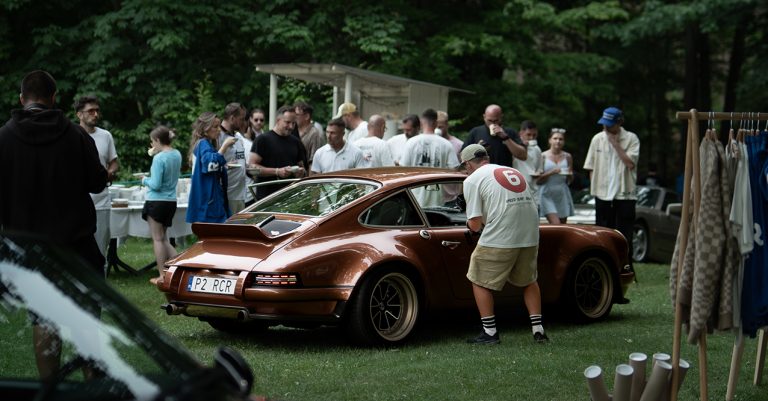
Contemporary luxury all too often tries to speak the simple language of immediacy. In the world of mass production, everything has its repeatable counterpart on the assembly line and a predetermined place in the price list. There are, however, projects whose value is defined in an entirely different way—through the amount of human attention, uncompromising craftsmanship, and thousands of hours locked away beneath a metal shell.
When a Porsche 964 serves as the foundation and the goal is to create a unique work of engineering, the question of budget naturally evolves. It ceases to be a question about the product itself and becomes a question of time. Because in our workshop, the time of our skilled workers is our most valuable currency.
Work done by human hands that cannot be sped up
Building a single car is a process of deep restoration that uncompromisingly rejects the notion of haste. It all begins in the absolute silence of the workshop, starting with stripping the donor car down to bare metal. Every historic component passes through the hands of specialists who restore it to factory condition or redefine it.
Just taking the car apart, meticulously restoring the mechanical components, building the engine from scratch, and precisely installing the new body panels takes an average of 2,500 hours of pure, physical labor. No shortcuts, no cutting corners.
The next 900 to 1,100 hours consist of silent, almost meditative work in the paint booth. It is there that the body gains its depth and the perfect refraction of light on the flared fenders. Once the body is ready, a master upholsterer spends over 250 hours meticulously crafting the interior with the finest leathers and Alcantara.
Independence of Thought and Technology
In a world where most projects rely on off-the-shelf components from catalogs, RCR forges its own path. The entire conceptual design, prototypes of unique parts, CNC-milled components made of aerospace-grade aluminum, and custom molds for carbon-fiber parts are all created on-site, within the walls of our workshop. From the first sketch to the finished part, which blends perfectly with the body’s lines.
A team of about thirty different specialists works on each vehicle: powertrain engineers, sheet-metal workers, composite structure experts, and leathercraft artists. Each of them leaves a piece of their passion and dedication in the car.
This process cannot be automated or replaced by a machine. To maintain a level of quality that knows no compromise, only 4 to 5 cars leave our workshop each year. This is not a production facility. It is an artistic engineering studio.
Investment Outlook
In this world, the budget is no longer just the cost of purchasing items; it becomes the equivalent of unparalleled craftsmanship. Investors who come to RCR fully understand this relationship. They know that a professional restomod of classic cars is advanced engineering that completely frees the car from its stock limitations.
Once we strip away the layer of raw emotion from the project and turn to cold, hard math, it turns out that such a deep, meticulous restoration of a Porsche 964— involving a complete powertrain overhaul, ultra-light carbon-fiber body panels, custom details, and a sophisticated interior—is a realm whose threshold naturally begins around 500,000 € for the comprehensive transformation process alone.
It is a value built on hard data, high-quality materials, and the knowledge of people who cannot be cloned.
In this form, the number stands out more, but thanks to the surrounding references to engineering and carbon, it still retains its exclusive, subtle character.
The Meaning Hidden in Movement
However, a finished RCR isn’t built to sit in a sterile gallery as a monument to human patience. The true quality of its craftsmanship and the number of refined details only become apparent once the car starts moving. In the workshop, precision is what counts. On the road—character.
Before the owner turns the key in the ignition, the car undergoes a final inspection. We work through a rigorous checklist, checking every electrical circuit and every scratch in the paint.
The air-cooled engine undergoes a demanding break-in and fine-tuning process, during which we cover between 500 and 1,000 kilometers of test driving. Only when the mechanical sound of the exhaust system and the driving characteristics are in perfect harmony with the driver’s intentions do we consider the project complete.
RCR doesn’t try to compete with flashy, ostentatious luxury. It is a contemporary interpretation of a classic that speaks the language of facts, analog emotions, and time transformed into a mechanical work of art.
Made in Poland.
Built for the road.