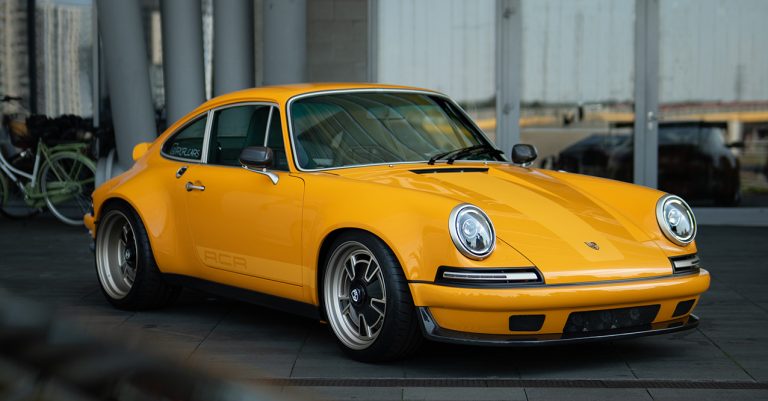
There are events where a car needs to stand out so it doesn’t get lost in the crowd.
Ultrace 2026 definitely fell into this category. Several hundred handpicked cars, an international community, drifting, projects from all over Europe, automotive icons, and an energy that felt more like contemporary automotive culture than a classic car show.
That’s where we unveiled RCR’s latest project—a car with the working title “Signal Yellow.”
Not as a tuning statement.
Not as an attempt to fit in with the most flashy part of the scene.
Rather, it’s a calm but very clear voice in the conversation about what a classic Porsche 911, rebuilt from scratch, could be today.
Ultrace — Contemporary Automotive Culture
For years, Ultrace has been more than just an automotive event. It’s a place where the various facets of car culture come together: tuning, custom, stance, motorsport, drift, design, lifestyle, and the passion for collecting.
The 2026 edition was special for another reason as well. After years spent in Wrocław, the event moved to Gdańsk, opening a new chapter in its history. Polsat Plus Arena and its surroundings created a space for a larger scale, new zones, and a completely different energy—more open, seaside-like, yet still very intense.
In a place like this, it’s not enough to just show up in a cool car.
Ultrace calls for a design that has character, consistency, and its own identity—a car that makes people stop not just because it’s loud, low, or flashy, but because they sense that a deliberate decision lies behind its form.
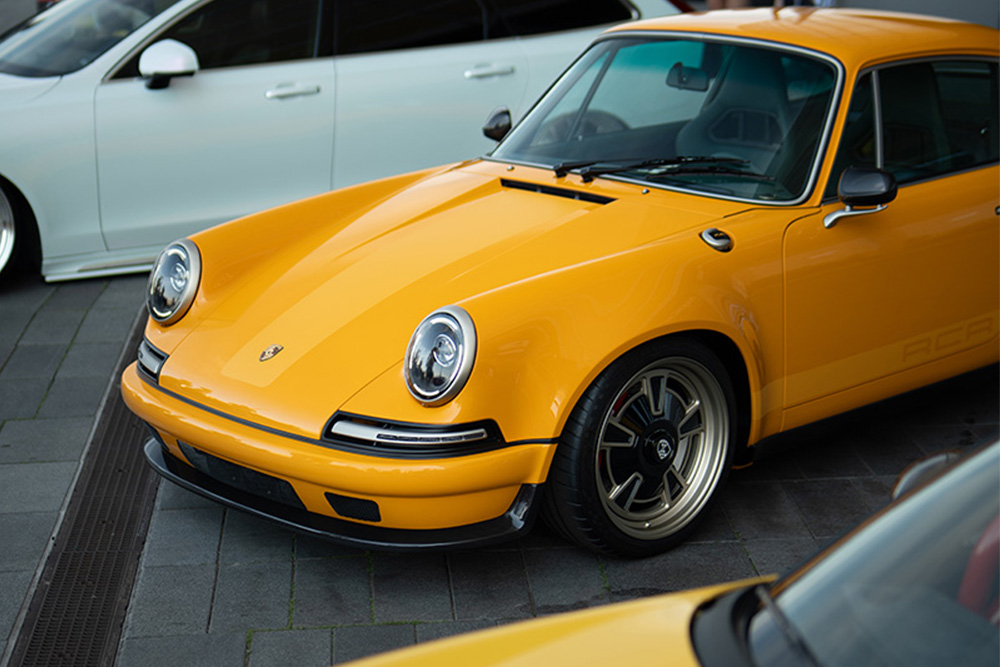
Signal Yellow
The latest RCR, tentatively named Signal Yellow, is just such a project.
The color immediately catches the eye. It’s bold, direct, and very striking. But this car isn’t just about the color. Signal Yellow works because there’s more beneath the surface: the proportions of the classic 911, handcrafted work, attention to detail, lightness, and mechanical authenticity—the foundation upon which we build every RCR project.
This isn’t a car that’s trying to pass itself off as a production classic.
And it’s not a car that’s trying at all costs to become part of the tuning scene.
This is a modern reinterpretation of the classic Porsche 911 —built around the driver, craftsmanship, precision, and the analog joy of driving.
Not tuning. Reinterpretation.
Ultrace is the natural setting for bold designs. Many of the cars at the event embody radical modifications: width, suspension, geometry, color, sound, detail, and stage presence.
RCR is also a radical project, but in a different way.
Not because of excess.
Not because of a random effect.
Not because of change for change’s sake.
RCR’s radical approach lies in its consistency. The question is: what elements of the classic 911 are worth preserving, what can be rebuilt from scratch, and what must not be lost if the car is to remain truly analog.
That’s why, with Signal Yellow, the most important thing isn’t that the car attracts attention. The most important thing is why it makes people stop.
Because beneath the color lies the mechanics.
Beneath the detail lies the decision.
Beneath the form lies the driving experience.
Among one-offs, legends, and contemporary reinterpretations
One of the things that sets Ultrace apart is its ability to showcase cars from very different worlds side by side—custom builds, collector’s cars, restomods, legendary race cars, and vehicles that don’t easily fit into a single category.
That is precisely why the context of this event was so interesting to RCR.
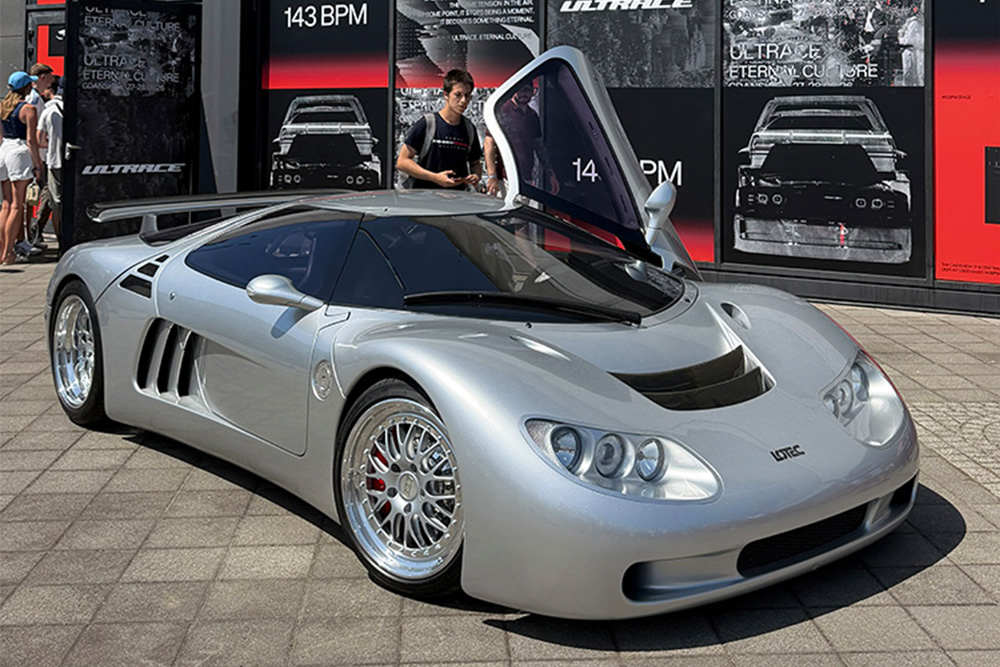
Among the cars on display at Ultrace were, among others, Lotec designs—cars that are, in and of themselves, a symbol of German engineering boldness and an era when the automotive industry still made the nearly impossible possible. Lotec is not a brand with mass recognition. Rather, it is a name for those who understand what a car built outside the obvious market norms is: rare, uncompromising, often one-of-a-kind—more of an engineering experiment than a mass-produced product.
Cars like these really capture the essence of Ultrace. This event isn’t just about showcasing what’s trendy. It’s about bringing together designs that have their own language—sometimes radical, sometimes historical, sometimes purely technical.
Alongside them were cars of a completely different caliber: legendary race and rally cars, including the Mercedes CLR—a car that went down in motorsport history as one of the most extreme and memorable prototypes of the late 1990s. It’s a car that reminds us that motorsports at the highest level have always been a realm of risk, aerodynamics, courage, and the very fine line between genius and unpredictability.
In the same vein, visitors could also see contemporary restomods, such as the Mercedes HWA EVO. This is a particularly interesting project because it’s not just a simple return to the classics. It is a modern interpretation of the Mercedes 190E 2.5-16 Evo II—a car with a rich motorsport history—reimagined through the lens of contemporary engineering, materials, and performance.
For RCR, being present in such an environment was important.
Signal Yellow doesn’t try to speak the same language as Lotec, Mercedes CLR, or HWA EVO. But it operates within a similar framework of thinking about the car: as an original, deliberate design, rooted in history but not confined to the past.
This is not a standard configuration.
This is yet another unique chapter in the RCR story—hand-built, based on the classic Porsche 911 design, yet defined by modern precision, proportions, attention to detail, and the analog joy of driving.
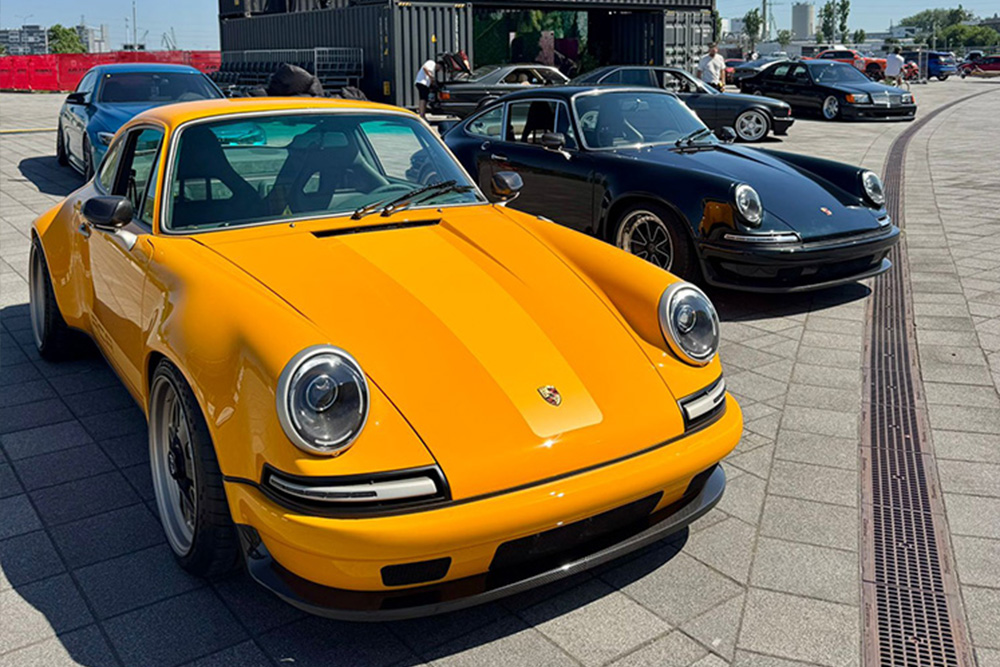
Poland’s Voice on the Global Stage
Ultrace is an event that brings together cars and creators from various countries, representing a wide range of approaches to car building. In this context, RCR’s presence is particularly significant to us.
We don’t present the car as a curiosity from Poland.
We showcase a Polish workshop that is forging its own style in the world of Porsche 911 restomods—a style rooted in craftsmanship, materials, proportions, and the driver’s experience.
So Signal Yellow was more than just another car at the event for us. It was a sign that RCR isn’t just a single project, but a growing brand. A brand with its own philosophy, its own pace, and an increasingly distinct way of telling the story of classic cars.
A car must have its own language
Ultrace is intense—visually, aurally, and energetically. It’s a place where you can easily get lost if a project lacks a distinct identity.
Signal Yellow did not try to respond to this context more loudly than others.
It wasn’t about making the biggest impact.
It wasn’t about the most aggressive style.
It wasn’t about conforming to a single trend in the scene.
The idea was to show that RCR has its own way of talking about a car: through proportions, handcrafted details, materials, and an analog connection with the driver.
Among hundreds of unique designs, Signal Yellow stood out not only because of its color. It stood out because of its consistency.
Built in Poland. Made for the road.
Signal Yellow is the next step in RCR’s development.
More daring in color.
More direct in its presence.
Still true to what matters most to us: classic design, handcrafted details, mechanical engineering, and the analog connection between driver and car.
Ultrace 2026 was a good place to demonstrate that.
Because, among hundreds of unique projects, drifting, sound, lights, and contemporary automotive culture, RCR didn’t have to be the loudest.
All it took was for him to speak his own language.